News
Finding Acceptance in an Unforgiving Place
By Shai Tamari
We sat in a circle, a group of men, most eyes fixed on the floor — anywhere but on each other. In the distance, a train whistle sounded, followed by gunshots from a nearby range where correctional officers train. It was my second session of a full-semester course at a prison in North Carolina.
For the past five years, I’ve taught “Internal & Interpersonal Conflict Management,” an undergraduate course at the University of North Carolina at Chapel Hill, inside prisons across the central part of the state. My students, incarcerated men and women, earn college credit through the UNC Correctional Education Program. I’ve taught in minimum, medium and maximum security facilities, including on death row, where students can attend but, under North Carolina law, cannot earn credit.
The first few sessions are never easy, for anyone. But doing this work inside a prison adds a layer all its own. My students are working out how far they’re willing to go into their emotions, how much trust they’re willing to extend — to me, to each other. Mostly, they’re trying to figure out how much they can trust themselves.
The course gives students a space to examine their relationship with conflict: the conflict within them, and the conflicts they have had, and continue to have, with others. More often than not, it was unresolved conflict, unhealed wounds, a lack of support and actions that harmed themselves or someone else that landed my students behind bars — or, more precisely, behind a fence. For most, this is the first real opportunity to look back at their childhoods, to examine their past and present relationships, and to understand not just who they are now, but how they became that person.
Together we practice new ways of listening: how to follow another person’s journey, what not to do when someone is upset, how to give someone room to be heard. In learning to do this for others, we are also learning to do it for ourselves. We talk about our relationship with apology and with forgiveness, and we sit with the shame and regret of ending up in prison, sometimes not for the first time.
My students range in age from 18 to 70. Some have been incarcerated for months, others for decades. Some have release dates ahead of them; others may never see the outside of a prison again. Every student in this course is there by choice. As one put it: “This shit doesn’t work anymore.” He meant his choices, his actions, the way he saw himself and everyone around him. They come to this course looking for a way to do better — to repair what’s broken in their relationships with their children, their spouses, their parents and themselves.
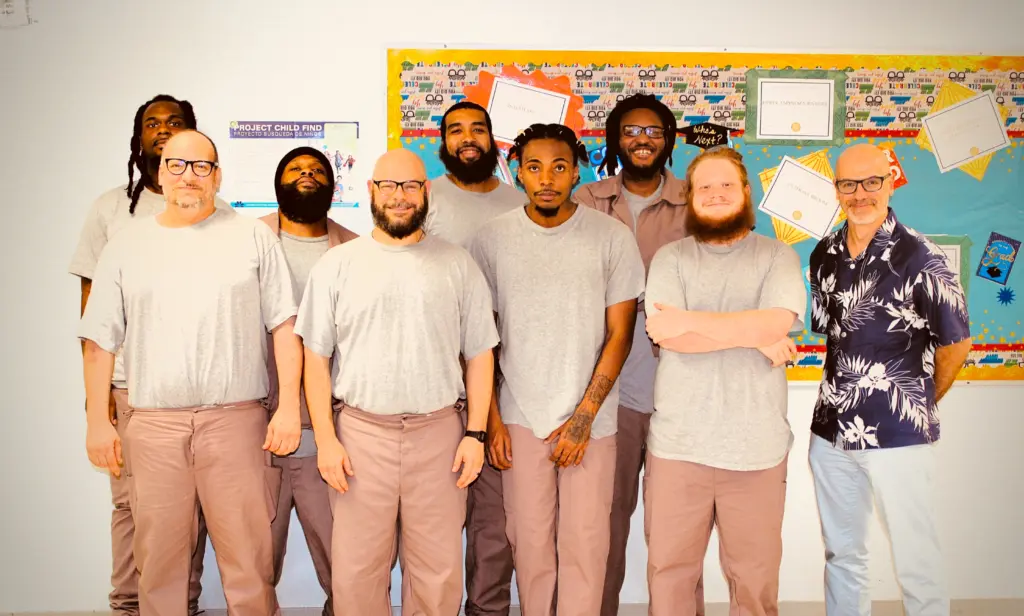
By our final session — the one that had opened with no one able to look at each other — the same men walked in chatting and smiling, to find a row of pizzas waiting, there to mark the end of the course. Each received a certificate of completion. As we went around the circle reflecting on the past few months, one student said he had started his own discussion group in the yard. Another said he had begun greeting people with “good morning” in the dining hall. A third arrived at a realization out loud: if everyone in this room had been carrying these same struggles, then surely the people in the yard who hadn’t taken the course were carrying them too. He challenged the group to reach out to those men — to ask how they were doing, to make connections, to see each other as human, and to make one another feel like they belonged.
That, in the end, is what the course is for. Not to excuse what brought any of us to that circle, but to insist that the people sitting in it are still capable of listening, of apologizing, of change — and that a prison, of all unforgiving places, can still be where that work begins.
Shai Tamari is a Professor of the Practice in the Curriculum in Peace, War, and Defense and the Department of Public Policy. He also directs the minor in Conflict Management.


