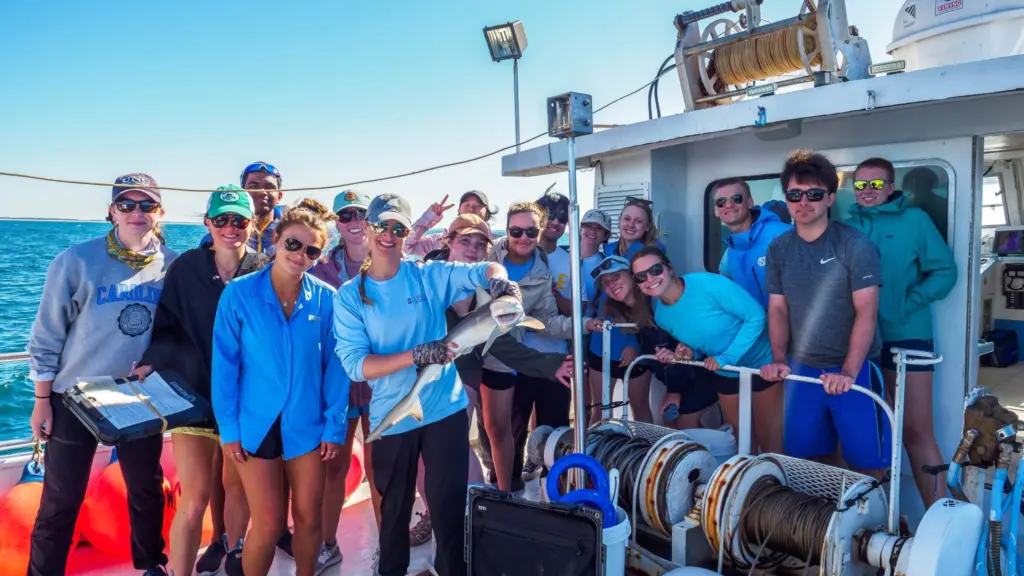
MOREHEAD CITY – On a breezy May morning, a Carolina blue sky stretched over the docks at UNC’s Institute of Marine Sciences. A group of Tar Heels leaned over the edge of a research boat to measure and tag a small shark before releasing it back into the water. In this open-air classroom, students explored one of the ocean’s most misunderstood species and gained a firsthand look at how Carolina research benefits the state’s coastal ecosystems and the communities that rely on them.
Offered during Maymester, EMES 89: Shark Ecology and Conservation immerses first year students in an exploration of the biology, ecology and conservation of sharks through hands-on fieldwork and data collection. Under the guidance of Dr. Joel Fodrie, a professor of marine sciences who has led UNC’s coastal shark survey for the past decade, this class is out to prove that there is nothing fishy about hands-on science, even when the science is fish.
“Sharks are the perfect entry point for learning how ecosystems work,” Fodrie said. “They’re top predators, but also barometers for the health of our coastal environments. When students study sharks in the wild, they’re studying how all parts of a system fit together.”
Over three intensive weeks at the coast, students study shark senses, discover drivers of change among sharks, and uncover the role these top predators play in keeping salt marshes, oyster reefs, and seagrass beds in balance. The field work is rigorous, but for many, it’s the highlight of their Carolina experience.

“EMES 089 was without a doubt the most fun and interesting course I’ve taken,” said student Eli Rector. “Most of my assignments involved hands-on work with sharks, and spending my free time at the beach made the experience unbeatable. All in all, if you get the chance to take EMES 089, you definitely should!”
For Katharyn Hendricks, another student in the class, the course brought science to life. “The Shark Ecology course has been the best experience of my time at UNC so far,” she said. “I gained not only a wealth of knowledge but also priceless hands-on experience. From catching sharks in the field to exploring diverse ecosystems, I was able to study how sharks live in their natural habitats. The people were amazing, and the professor was not only a fantastic teacher but also organized the class in an outstanding way.”
Insights from the shark surveys support healthy ecosystems, protecting the state’s coastal heritage and helping coastal communities adapt to environmental change.
“Sharks are a gateway for students to understand the bigger picture,” Fodrie said. “They’re learning about ecosystems, data collection, and conservation, but they’re also learning what it means to do science that matters to people and places right here in our state.”
Offered again in Maymester 2026, the Shark class promises another season of discovery and hands-on science. Students interested in the Shark Biology, Ecology and Conservation course can learn more at an online information session on October 23 from 6 to 7 p.m. ET, part of the University Research Week.